20 years ago, How will we manage if we get the similar situation again?
One Love Reggae- Bob Marley
Wednesday, July 16, 2008


Sunday, July 13, 2008
The 2010 Election Challenges
Burma's conflict is moving into a new phase of intractability. In other words, the conflict will become institutionalized in 2010.
The military has unilaterally set the rules of the new game with the ratification of its constitution and is preparing to hold elections in 2010 as part of its seven-step “roadmap.” But the new constitution will not bring about much-needed state-building, a process in which all parties rally together and make their voices heard.
Instead of entering into the state-building process, Burma ranked 12th out of 177 states in order of their vulnerability to violent internal conflict and societal deterioration in the 2008 “failed state” index, presented by Foreign Policy magazine and the Fund for Peace. In the 2007 index Burma was designated 14th in failed state rankings. The country is crumbling.
"I can't really see anything happening that will be positive for the country's better future at this stage," said David Steinberg, a Burma expert from Georgetown University in Washington, DC.
The incompatible goals of the military elites and the opposition, including ethnic minorities, will not be transformed by the new constitution and the 2010 election.
The opposition will continue to fight for the goal of national reconciliation but is likely to find itself ineffective within the new institutional procedures that favor the military's exclusive domination. As result, the opposition will have to pursue alternative course of actions—such as public mobilization and international advocacy.
On the other hand, since the military continues to impose its one-sided goal of exclusive domination with the new constitution and elections it cannot expect to minimize the cost of conflict. The most visible costs of this approach will be the continuation of international isolation and further damage to the country's economy.
"We do not accept the junta's unilateral solution," said Aung Din, a former political prisoner and executive director of the US Campaign for Burma. "Until and unless there is a negotiated political settlement, made by the military, the National League for Democracy led by Daw Aung San Suu Kyi, and ethnic representatives together, the US-led western sanctions against the junta will not be lifted."
Sein Htay, a Burmese economist in exile, goes further, saying: "No matter whether there are western economic sanctions or not, the regime's policy failure and mismanagement will damage the prospect of development and public welfare. The country's economy will continue to worsen after 2010."
The threat of renewed public uprisings will still be present, since the military's intentions do not facilitate a reconciliation of interests. More repression will result, increasing existing grievances and public hostility towards the military.
"As the generals will use the same method of coercion against the people even after 2010, the existing public anger that reached an unprecedented high level during the crackdown against monk-led protests last year and the regime's negligence of cyclone relief in May will then be compounded," said Win Min, a researcher in civil-military relations in Burma. "Antagonistic civil-military relations will continue."
Apart from being unable to transform incompatible goals and relations, the new, post-2010 regime will not change any salience of the issues that the country has been facing and which have earned it pariah status.
According to the military's new constitution, a military chief will independently administer military affairs, including recruitment and expansion of troops, promotions, troop deployment, budget, military-owned businesses, purchase and manufacture of weapons, etc.
Consequently, the issues of child soldiers, forced relocations, forced labor, landmines, internal displaced person, the flow of refugees to neighboring countries, rape and other rights violations—all of which are associated with the military's unchecked interests and behavior— will continue unresolved, especially in ethnic areas such as the eastern areas of Burma.
Since the elected parliament’s legislative power will be restricted and because it will not be able to oversee the military, no civilian mechanisms will be available to redress the military’s excesses. Military personnel accused of crimes will be tried by a court-martial appointed by the head of the armed forces, the Tatmadaw—effectively allowing the military to continue its violations with impunity.
The 2010 elections could, however, contribute to leadership changes, at least on a nominal level during the initial stage. Two power centers will be created—military and government.
Aside from the 25 percent of parliamentary seats reserved for the military and its power to appoint the three most important cabinet ministers (Defense, Home and Border Area Affairs) in the Cabinet, the generals are determined to fill the remaining government portfolios and parliamentary seats with members of its own civilian thuggish movement, the Union Solidarity and Development Association (USDA).
The election is sure to be marked by vote rigging, intimidation and bullying attacks orchestrated by the USDA and its affiliates against opposing candidates. Given the record of USDA violence against Suu Kyi's entourage in 2003 and opposition activists in subsequent years, the world will witness an election model of goon-squad democracy—comparable to the travesty of recent elections in Zimbabwe.
The new post-election power arrangement will nonetheless create conflict between two power centers over the command structure and personal interests. Even now, various reports confirm that there is serious animosity and tension between military personnel and USDA members regarding the latter's interference with the military's administrative mandate and other issues of self-interest.
Given the military's lack of experience of sharing power, it will be harder for the generals to accept being outshone by the USDA.
"Many officers in the military hate the USDA and believe it will go down when Than Shwe goes," said a source close to the military establishment.
The government's operation with two centers of power—no matter who pull the strings—could lead to either a serious internal split or miserable inefficiency of the ruling body.
Some advocates expect it will take an evolutionary shift toward liberalization. They believe the military's constitution, although flawed, can give reform options to a new generation of military officers. They suggest "using the generals’ flawed model of democracy as a starting point from which to pursue a more acceptable long-term solution."
However, the nature of the power rivalry within a post-2010 regime will not necessarily lead to a new opening and democratization in the long run. Even if it does so, the question is: how long is the long run? It may be too long to have any strategic relevancy for the opposition movement, within the country as well as abroad.
In fact, political transition is not likely to take place within the framework of a military-imposed constitution. Even amendments made to the constitution in the hope of gradual reform will not be possible within military-dominated parliamentary debate and a new power arrangement. It could happen only if the status-quo is challenged by public pressure and a negotiated settlement is reached with the military. Otherwise, the post-2010 prospect remains bleak.
The UN-led international community, therefore, must double its efforts to push for an inclusive political resolution in Burma before 2010, mediating for meaningful political dialogue among all key stake holders by using coercive diplomacy, rather than pleading to the regime to conduct elections that are just "credible and inclusive".
The international community must be fully aware that the result of the election will be in accordance with the military's constitution. Otherwise, it will make the same major mistake committed by EU leaders at their July 19 summit in Brussels when they called on the military junta "to ensure that the elections announced for 2010 will be prepared and conducted in a way that contributes to a credible and fully participative transition to democracy." Without considering contextual and consequential dangers, the EU leaders just pushed for the 2010 election and perhaps felt they were serving the cause of Burmese democracy. Moral misery and strategic blunder!
UN envoy Ibrahim Gambari, who is planning to return to Burma soon, should be especially cautioned not to lend legitimacy to the regime's constitution and elections in 2010. The UN, which once supported the junta's seven-step “roadmap” as a potential for an inclusive transition, must now say clearly that the map is no longer relevant since it has failed to incorporate key stakeholders.
In brief, the UN-led international community should not give up its attempt to enforce an inclusive political resolution in Burma before 2010.
Wednesday, May 7, 2008
MAY 20, 2008: WHAT'S NEW
Friday Evening
 |  |
| Some 2.5 million people have been affected by the cyclone |
 Listen to Audio
Ban: Burma to allow aid in
The United Nations Secretary General, Ban Ki-moon, says Burma's military leadership has agreed to let in all foreign aid workers to help cyclone victims.
Mr Ban's announcement followed a meeting with Burma's secretive leader, General Than Shwe.
UN officials said the general agreed that aid workers would be allowed into the worst-affected Irrawaddy Delta region.
The UN described this as a significant move in principle.
Aid agencies have cautiously welcomed the apparent breakthrough -- coming three weeks after the cyclone struck -- but observers say Burma has reneged on past promises to the UN.
 Burma's military leaders greet UN head Ban Ki-moon
Our Reports also include:
- View of Sitagu Sayadaw Ashin Nyanissara on current development of government response to international aid offers.
- Responses of international aid agencies on Burma's decision on accepting international aid workers.
African aid helicopters scrambled to Burma
|  |
| USS Essex navy ship stationed near Burma, ready to help cyclone victims |
It's unclear whether the Burmese offer applies to military aid workers -- and whether American naval helicopters stationed off the Burmese coast can join the relief effort.
Burma earlier this week gave permission for just ten UN helicopters to begin relief flights.
But most of these are in Africa, and the UN has asked the US, Britain, Canada and Australia to help transport these large helicopters to Burma.
A BBC correspondent says the helicopters need to be dismantled first and reassembled upon arrival. He says this could take a week.
Also in the news..
- Account of a Burmese medical doctor who has been helping cyclone's victims in the delta region.
- U Nyan Win, a spokeperson of NLD said the extension of the house arrest of beyond May 30 would not be in accordance with current law.
Daw Aung San Suu Kyi has been detained since 30 May Depayin attack five years ago.
Also in the programme..
Burma Perspective By U Maung Maung Than
"Political landscape of Burma after the Constitutional Referendum"
Cautious Optimism over Than Shwe-Ban Agreement
| By WAI MOE | Friday, May 23, 2008 |
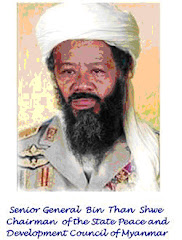
The leader of Burma’s ruling junta, Snr-Gen Than Shwe, has finally agreed to allow in “all aid workers” after meeting with the head of the United Nations in the country’s capital, Naypyidaw. But given the regime’s history of mistrust towards non-governmental organizations and UN agencies, most greeted the news with cautious optimism.
“I had a very good meeting with the Senior General and particularly on these aid workers,” said UN Secretary-General Ban Ki-moon. “He has agreed to allow all aid workers regardless of nationalities.”
 |
| UN Secretary-General Ban Ki-moon (L) met with Burma's junta leader Snr-Gen Than Shwe on Friday in Naypyidaw. (Photo: AP) |
Burma’s main opposition party, the National League for Democracy (NLD), called the news a positive step, provided the junta keeps its promises.
“We will be very glad if that news comes true,” Nyan Win, a spokesman for the NLD, told The Irrawaddy on Friday. “But the good news should have come for survivors immediately after the cyclone hit the country. Now it has been three weeks.”
Several Bangkok-based aid workers who were waiting to get a visa to enter Burma also responded cautiously to the announcement, noting that the regime has a history of not keeping its promises.
Foreign aid workers already inside Burma need permission to travel outside of Rangoon—another hurdle that will need to be cleared before an effective response to the disaster is possible.
But some Burma watchers regarded Than Shwe’s decision to allow foreign aid workers into the country—after weeks of refusing to even respond to telephone calls from the UN secretary general—as a genuine concession.
Aung Naing Oo, a Burmese political analyst, said that Than Shwe needed to make a compromise after facing weeks of unrelenting pressure.
He said that this pressure was both internal and external, leaving the junta’s top general with no other choice than to end his resistance to calls for a larger international aid effort.
“I heard even Burmese military officials are displeased with the junta’s poor relief distribution system in the delta region and slow response to international aid,” he said.
Many local Burmese aid workers who have been to delta region said that doors that have been opened slightly can just as easily be closed again. “This is the nature of the Than Shwe regime,” they said.
Larry Jagan, a British journalist who writes on Burma affairs, said he was rather doubtful that Ban Ki-moon’s remark represented a major breakthrough.
“I cannot believe that Snr-Gen Than Shwe is going to allow thousands of foreigners to delta region,” he said.
Some analysts said that Than Shwe may be worried about the possibility of the Burma issue being raised again at the UN Security Council.
France said on Thursday that it would push for a Security Council resolution authorizing the aid delivery to Burma’s cyclone victims “by all means necessary” if pressure from Ban Ki-moon and neighboring countries doesn’t work.
The French ambassador to the UN, Jean-Maurice Ripert, said that France will wait to hear from Ban Ki-moon and John Holmes, the UN humanitarian chief, as well as from the Association of Southeast Asian Nations, to see if there is any concrete progress on the issue of access to the victims.
“If not, we will have to go back to the Security Council,” said the ambassador.
Authorities Tighten Restrictions on Private Aid Efforts
| By MIN LWIN | Friday, May 23, 2008 |
Private aid convoys from Rangoon, which have provided a lifeline to victims of Cyclone Nargis in some hard-hit areas of the Irrawaddy delta, are facing tighter restrictions by local authorities, who say that the government now has the situation under control.
At a checkpoint near the Panhlaing Bridge in Rangoon’s Hlaing Tharyar Township, trucks and other vehicles carrying supplies to the delta are being stopped and inspected, according to local nongovernmental organizations and other private donors.
“The security officers told me not to distribute things along the road and gave me a pamphlet,” said a relief worker who passed through the checkpoint, where guards recorded license plate numbers of vehicles traveling to Kungyangone and Twante Townships located in the Irrawaddy delta.
According to the relief worker, the pamphlet claimed that the government had completed its emergency operations in the area, and was now undertaking efforts to rehabilitate the local population. It added that private donations were disrupting these efforts, as they made people in the area less willing to work.
Relief workers who have visited some of the hardest-hit areas deny that the government’s efforts have been effective in dealing with the crisis, which they say remains far from over.
Meanwhile, private donations—of money, food, water, clothing and other basic necessities—continue to be collected throughout the country.
Much of this informal aid effort is being handled by Buddhist monks, who are overseeing the distribution of scarce resources to cyclone survivors in areas that have seen little assistance from the government.
“I am afraid that the victims won’t receive the assistance,” said one donor, explaining why he declined to make donations through the government.
Sunday, March 30, 2008
THE GLEANER (JAMAICA'S LOCAL NEWSPAPER)
Burmese to stage protest in Jamaica
published: Monday | May 12, 2008
Janet Silvera, Senior Gleaner Writer
WESTERN BUREAU:
Burmese expatriates in Jamaica will today stage a peaceful march to show solidarity with their countrymen who were devastated by a cyclone last week and have received negligible aid because of tight controls by the military dictatorship.
The protest will commence outside the United States Embassy in St Andrew at 9 a.m.
Spokesperson for the group, Dr Soe Naung, told The Gleaner the Burmese would march from the embassy to the offices of the United Nations.
"The march is to express our sympathy and condolences to those who died in Cyclone Nargis and to show solidarity, concern and care for those who live and are trying to survive there (in Myanmar)," the medical doctor said.
Showing gratitude
In addition, he said the group wants to show gratitude to two nations - the United States and France and two organisations, the European Union and the United Nations.
"Even though the junta is refusing to allow aid workers access into the country, we are urging these nations and organisations to do even more," said Naung.
The death toll in the Asian nation remains uncertain. Up to press time, media reports claimed the death toll had jumped to 28,000.
British aid group Oxfam was also quoted on Sunday as saying that the death toll could rise to 1.5 million if people do not get clean water and sanitation soon.
"Over two million are homeless, and are facing the aftermath of tropical diseases," said Naung, who still has relatives living there.
Bloody hands
One of the most important issues on the expatriates' agenda is to ensure that the Jamaican Government and all other countries attending the Law of the Sea Conference here in June do not welcome or "shake the bloody hands" of the two military Burmese representatives who are billed to attend the event.
"We are requesting that those attending the conference will use their own liberty to promote the need for ours and help us rejoin the family of free nations," urged the Burmese doctor.
Myanmar (formerly called Burma), which got independence from Britain in 1948, was placed under military rule in 1962 during a staged coup by the late General Ne Win.
Second-generation military leader, General Than Shwe, has been running the country since Ne Win's death.
Wednesday, March 12, 2008
04 May, 2008; News Update
Saturday Dawn
|  |
| The US has ships with aid standing by in the Gulf of Thailand |
Burma warned over cyclone delays
The United Nations Secretary-General, Ban Ki-moon, has warned that hundreds of thousands of Burmese lives could be at risk, unless the military government removes all restrictions on foreign aid following Cyclone Nargis a week ago.
The UN has appealed for almost two hundred million dollars in aid from member countries.
The Burmese ambassador to the UN (Kyaw Tint Swe ) said his country would accept help from any quarter.
His government has said it is not ready to allow in foreign search and rescue teams but the UN's head of humanitarian affairs, John Holmes, said he believed Burma could become more flexible after the constitutional referendum this weekend.
Burma: diseases start to take hold
|  |
| Thousands of people in the area have received no aid |
Two BBC correspondents who've travelled to the Irrawaddy delta, the area worst-hit by the cyclone, say tens of thousands of bodies are strewn across the landscape, with houses toppled and trees uprooted.
They say diseases like dysentery are already starting to take hold, and although some aid has arrived there is still no relief effort to match the size of the catastrophe.
Burmese referendum underway despite cyclone
|  |
| Burmese referendum underway despite cyclone |
A constitutional referendum is underway in Burma, despite appeals from the United Nations for a postponement because of the devastation caused by Cyclone Nargis a week ago.
Voting is taking place in most of the country although the poll has been delayed for two weeks in the worst-affected areas (including the main city, Rangoon.
Also in the news:
- Early morning preparations for referendum across the country.
- Prayer vigils, donations around the World for Cyclone victims of Burma.
Subscribe to:
Posts (Atom)